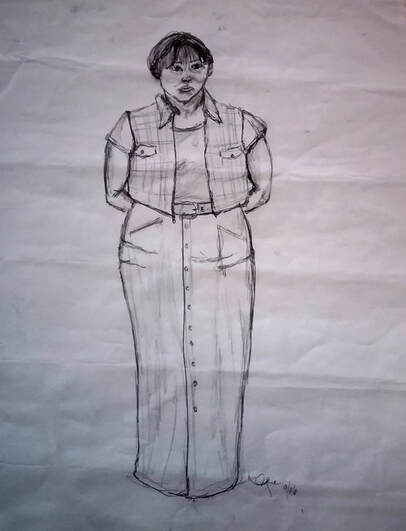
Body Dysmorphia, Mirror Drawing, M.L. Gardiner (1996)
"Inflated Body, Depleted Self: My Brain Lies"- Mirror Drawing, 1996
This mirror drawing from 1996 marks a pivotal moment in my recovery from an eating disorder and serves as a powerful example of how body distortion can profoundly alter self-perception, causing deep distress and inaccuracy. At one of the lowest and most malnourished points in my illness, I severely misjudged my size, often seeing myself as 50-60 pounds heavier than I actually was. This disconnect between mind and body, driven by malnutrition, created significant confusion and distress for me, my family, and my healthcare providers.
Mirror Drawings and Body Mappings are forms of At and Exposure Therapies, which can address body distortion and dysmorphia. Through guided sessions with a therapist, mirror drawing helped me confront the cognitive and emotional challenges of most of my eating disorder and the distress of body dysmorphia. Being undernourished at the time, the process powerfully reflected the overwhelming emotions I was experiencing, and anger.
To learn more about Expressive Arts and Exposure Therapies, including Mirror Drawing and Body Mapping, explore the resources below. These innovative approaches offer valuable insights and therapeutic support for individuals facing eating disorders, trauma, anxiety, and depression.
This mirror drawing from 1996 marks a pivotal moment in my recovery from an eating disorder and serves as a powerful example of how body distortion can profoundly alter self-perception, causing deep distress and inaccuracy. At one of the lowest and most malnourished points in my illness, I severely misjudged my size, often seeing myself as 50-60 pounds heavier than I actually was. This disconnect between mind and body, driven by malnutrition, created significant confusion and distress for me, my family, and my healthcare providers.
Mirror Drawings and Body Mappings are forms of At and Exposure Therapies, which can address body distortion and dysmorphia. Through guided sessions with a therapist, mirror drawing helped me confront the cognitive and emotional challenges of most of my eating disorder and the distress of body dysmorphia. Being undernourished at the time, the process powerfully reflected the overwhelming emotions I was experiencing, and anger.
To learn more about Expressive Arts and Exposure Therapies, including Mirror Drawing and Body Mapping, explore the resources below. These innovative approaches offer valuable insights and therapeutic support for individuals facing eating disorders, trauma, anxiety, and depression.
Ebbing, M.L. Gardiner (1996)
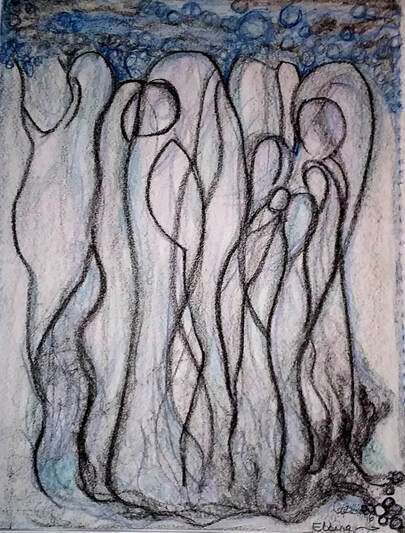
"Ebbing" - Learning to Be with Feelings, 1996
I was very fortunate to work with a therapist who introduced me to the enriching world of Expressive Therapy—activities like writing, drawing, painting, and etching—alongside Cognitive Behavioural Therapy (CBT) and Nutrition Counselling. This integrative approach allowed me to stabilize my nutrition but also nurture inner peace. Together, with my counsellor, we acknowledged the importance of slowing down, connecting with my inner world by exercising less often - and with reduced intensity - to give my body time to heal and to recover from setbacks that arose from over-exercising, such as stress fractures and electrolyte imbalances.
Art helped reveal how exercise had numbed me and created a false sense of safety, dulling my awareness of inner states and cues such as hunger and emotions. Embracing creative and present-oriented activities like drawing, etching, gentle walking, and gardening brought a pleasant, preferred peace. These helped me connect with my authentic self, needs, and boundaries - and the joys of living as a whole, feeling like a human being again.
This wax drawing (crayons!) is an expression of deep grief and overwhelm, of feeling choked off, of drowning in the currents of life. Past parts, present parts, and parts feeling as invisible as water wishing to be seen, muddied by the eating disorder and not knowing how to swim to the surface. Drawing invited the necessary slowing down to ground and recover - an opportunity to practice being present and to stop running from my emotions. Only in the stillness could I hear the grief. Treatment taught me to trust my capacity to survive the currents of life, no matter how turbulent.
When we're ready, we do. (A. Johnston, 2016)
I was very fortunate to work with a therapist who introduced me to the enriching world of Expressive Therapy—activities like writing, drawing, painting, and etching—alongside Cognitive Behavioural Therapy (CBT) and Nutrition Counselling. This integrative approach allowed me to stabilize my nutrition but also nurture inner peace. Together, with my counsellor, we acknowledged the importance of slowing down, connecting with my inner world by exercising less often - and with reduced intensity - to give my body time to heal and to recover from setbacks that arose from over-exercising, such as stress fractures and electrolyte imbalances.
Art helped reveal how exercise had numbed me and created a false sense of safety, dulling my awareness of inner states and cues such as hunger and emotions. Embracing creative and present-oriented activities like drawing, etching, gentle walking, and gardening brought a pleasant, preferred peace. These helped me connect with my authentic self, needs, and boundaries - and the joys of living as a whole, feeling like a human being again.
This wax drawing (crayons!) is an expression of deep grief and overwhelm, of feeling choked off, of drowning in the currents of life. Past parts, present parts, and parts feeling as invisible as water wishing to be seen, muddied by the eating disorder and not knowing how to swim to the surface. Drawing invited the necessary slowing down to ground and recover - an opportunity to practice being present and to stop running from my emotions. Only in the stillness could I hear the grief. Treatment taught me to trust my capacity to survive the currents of life, no matter how turbulent.
When we're ready, we do. (A. Johnston, 2016)
A Foot Out The Door, M.L. Gardiner (1996)
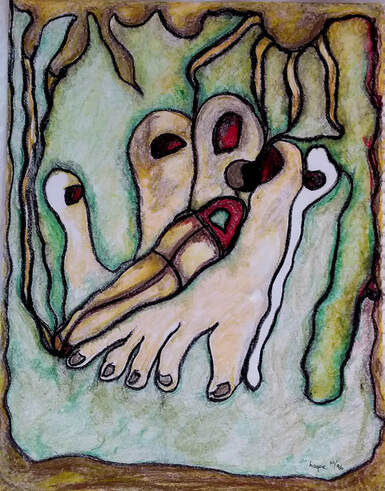
"A Foot Out the Door" - Heart-ache of Healing, 1996
Recovery is a profound journey that can be both enriching and empowering, yet can also present challenges. The process of letting go of learned behaviours, rituals, and compulsions—those things we cling to for a sense of safety—can be daunting, even when we know they may be harmful to our well-being. During my treatment, I faced a life-altering moment, a cardiac event.
The event served as a reminder of how malnutrition and electrolyte imbalance can affect the body - heart, brain, gut, bone, hormones and endocrine functioning. While I was committed to improving my nutrition, I continued to struggle with the tendency to misuse laxatives and over-exercise, pushing my body beyond its limits. Like a broken arm that I kept using, my body could no longer sustain the pressure, and I realized that this was it, my opportunity to live.
The experience shook me to my core. And, where I didn't have the words to share it or discuss it, I found solace in drawing my experience and reflecting on my feelings. When I was ready, I was able to share these reflections with my therapist and process the weight of the event.
What I now call the "May St Event, has deepened my understanding of my illness and ignited a renewed desire to embrace life and create a meaningful
future. While the road to recovery can be difficult, when we commit, it also offers growth, insight, and meaningful transformation.
Learn about Art Therapy for trauma by visiting Psychotherapy Networker.
Recovery is a profound journey that can be both enriching and empowering, yet can also present challenges. The process of letting go of learned behaviours, rituals, and compulsions—those things we cling to for a sense of safety—can be daunting, even when we know they may be harmful to our well-being. During my treatment, I faced a life-altering moment, a cardiac event.
The event served as a reminder of how malnutrition and electrolyte imbalance can affect the body - heart, brain, gut, bone, hormones and endocrine functioning. While I was committed to improving my nutrition, I continued to struggle with the tendency to misuse laxatives and over-exercise, pushing my body beyond its limits. Like a broken arm that I kept using, my body could no longer sustain the pressure, and I realized that this was it, my opportunity to live.
The experience shook me to my core. And, where I didn't have the words to share it or discuss it, I found solace in drawing my experience and reflecting on my feelings. When I was ready, I was able to share these reflections with my therapist and process the weight of the event.
What I now call the "May St Event, has deepened my understanding of my illness and ignited a renewed desire to embrace life and create a meaningful
future. While the road to recovery can be difficult, when we commit, it also offers growth, insight, and meaningful transformation.
Learn about Art Therapy for trauma by visiting Psychotherapy Networker.
"Connection" - Showing a Shift: A Series at Six Months, 1996
Around 8 months into my eating disorder recovery, nutrition stabilized, exercise was finally gentle and brief, and my skills for self-expression, regulation, and interpersonal communication had become more natural and normalized. I was feeling healthier, less depressed and anxious, and was feeling more connected and attuned to my body and life around me.
I exchanged beauty and fitness magazines for books that nourished my mind and interests, enjoyed quality time with pets, friends, and nature, and activities that filled me emotionally, intellectually, and spiritually. Long, intense runs that had left aching and broken bones and shifted to weekly adventures at colourful gardens and quiet pine-scented forests - activities I had loved as a child but had forgotten - lifted my senses and helped me feel human again!
These pictures capture the joy of this period of growth and increased connection. The previously broken sense of self from Ebbing is replaced by joy and a sense of oneness with the world, including a reconnection, even celebration, of the whole, feminine aspects of myself - creative, playful, and free parts that I had feared and rejected following traumatic events in life.
These drawings now resemble mature, empowered women central to the landscape, free to move, flow, and nurture without fear.
Around 8 months into my eating disorder recovery, nutrition stabilized, exercise was finally gentle and brief, and my skills for self-expression, regulation, and interpersonal communication had become more natural and normalized. I was feeling healthier, less depressed and anxious, and was feeling more connected and attuned to my body and life around me.
I exchanged beauty and fitness magazines for books that nourished my mind and interests, enjoyed quality time with pets, friends, and nature, and activities that filled me emotionally, intellectually, and spiritually. Long, intense runs that had left aching and broken bones and shifted to weekly adventures at colourful gardens and quiet pine-scented forests - activities I had loved as a child but had forgotten - lifted my senses and helped me feel human again!
These pictures capture the joy of this period of growth and increased connection. The previously broken sense of self from Ebbing is replaced by joy and a sense of oneness with the world, including a reconnection, even celebration, of the whole, feminine aspects of myself - creative, playful, and free parts that I had feared and rejected following traumatic events in life.
These drawings now resemble mature, empowered women central to the landscape, free to move, flow, and nurture without fear.
Finding Balance, M.L. Gardiner (1997)
"Finding Balance" - Second Mirror Drawing, 1997 Towards the end of treatment, I was finding balance. Nutrition stabilized, body distortion shifted, I was at a healthier weight for my body's build and needs, and I had found ways to exercise that felt good rather than punishing. I was doing it; I was juggling the key components of recovery and had created a solid foundation for a happier life in future! Learn about Maintenance and the Stages of Change at https://nedc.com.au/eating-disorders/treatment-and-recovery/stages-of-change/. |
Healthy, sustainable recovery also teaches us, empowers us, to become critical consumers of media and to appreciate the various forms of beauty and body diversity.
|
"Loss", "Anger" and "The Feeling In Joy"
As a therapist and human being, I continue 'arting' as a tool for authentic self-expression and in times when words feel inadequate, or too heavy to speak. And, the times when there just are no words to fit the pain, elation, or dreams within. Artistic expression empowers us to safely reveal our inner world and release our emotions and ideas from us and into the world. Art can be ELEMENTAL to our process of healing, continued coping and good health. As Georges Braque said, "Art is a wound turned into light". Art heals.
For more ideas and ways to practice art therapy, visit 100 Art Therapy Exercises. I hope these examples have inspired your curiosity and offered a deeper understanding of Expressive Art and Exposure Therapy as meaningful and complementary tools for recovery—whether from eating disorders, disordered eating, trauma, or the challenges of body image distress.
Happy "arting" and healing to you.
Warmly,
Michele
As a therapist and human being, I continue 'arting' as a tool for authentic self-expression and in times when words feel inadequate, or too heavy to speak. And, the times when there just are no words to fit the pain, elation, or dreams within. Artistic expression empowers us to safely reveal our inner world and release our emotions and ideas from us and into the world. Art can be ELEMENTAL to our process of healing, continued coping and good health. As Georges Braque said, "Art is a wound turned into light". Art heals.
For more ideas and ways to practice art therapy, visit 100 Art Therapy Exercises. I hope these examples have inspired your curiosity and offered a deeper understanding of Expressive Art and Exposure Therapy as meaningful and complementary tools for recovery—whether from eating disorders, disordered eating, trauma, or the challenges of body image distress.
Happy "arting" and healing to you.
Warmly,
Michele
“Art enables us to find ourselves and lose ourselves at the same time.”
– Thomas Merton